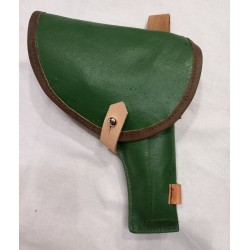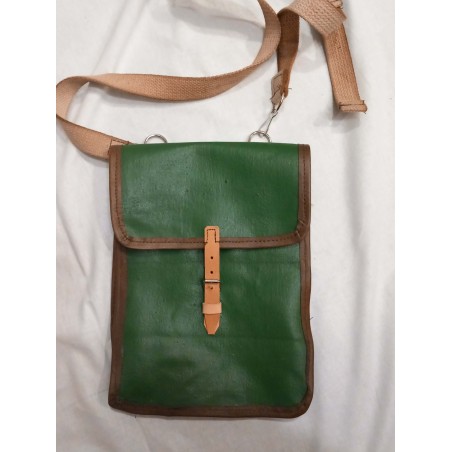


A perfect replica of an early NCO bag from World War II.

Bezpieczne płatności

Szybka wysyłka

Bezpieczna dostawa
A replica of a 1940 NCO bag, made of the correct green kirza. The reinforcements, fasteners, and sides are made of genuine leather.
The green kirza was used on obr.1938, obr.1940 and early obr.1941 NCO bags.
Below is a bit of history of the RKKA NCO bags:
Obr.1938 - The first sergeant's bag model used during World War II. It was the most spacious, had two internal pockets, and the entire bag fastened with a large flap similar to that found on officers' bags, fastened with a leather strap and eyelets. Beneath the flap were a compass pocket and pockets for writing implements. It was apparently made exclusively of green kirza. Despite this, it was reinforced with genuine leather. The straps were webbing, attached to webbing loops, which allowed the bag to be worn on the main belt.
Obr.1940 - The second wartime pattern. It was much simpler than the Obr.1938 pattern. It had one large pocket and two small pockets on the front, closed by a common small flap. The entire piece was covered by a larger flap, fastened with a leather strap and a single-prong buckle. The leather pockets for writing implements were moved to the outside, located on the side panel. The strap was also removable, as in the Obr.1938 pattern. The material used for the kirza was still green.
Obr.1941 - The third wartime pattern. It was essentially a simplified Obr.1940 pattern. The only difference was the removal of the writing instrument pockets. Most examples were still made of green kirza.
Obr.1941 Simplified - Wartime production necessitated further simplification. Most examples had a permanently sewn-in strap. Other fasteners for the main flap were also possible. Most examples were now made with brown kirza. There was also a black kirza.
Post-war pattern - Basically a return to the original Obr.1941 design, without subsequent simplifications. By this time, the kirza was only brown with a characteristic grained texture, which wasn't all that common during the war (which doesn't mean it didn't exist).

A perfect replica of an early NCO bag from World War II.